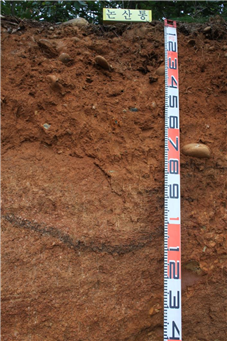
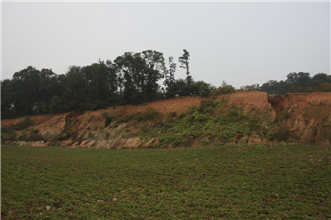
Morphological properties of typifying pedon.
|
|
NONSAN SERIES |
Established Series SJD, UKT, JYG Rev. 14 March, 1972 |
The Nonsan series are members of the fine loamy, mixed, mesic family of Typic Hapludults [Cutanic Alisols (Alumic Hyperdystric Chromic Novic) classified by WRB]. These soils have dark yellowish brown gravelly loam A horizons, yellowish red gravelly clay loam BAt horizons, yellowish red gravelly clay loam Bt1 horizons, strong brown gravelly clay loam Bt2 horizons, and strong brown and reddish yellow sandy loam 2C horizons. They occur on moderately dissected terraces and are derived from old alluvium.
Typifying Pedon: Nonsan gravelly loam-pine forest (Clors are for moist soil).
Slope: 7-15%
Elevation: 35 m above m.s.l.
Soil moisture regime: Udic
Soil temperature regime: Mesic
Parent material: Old alluvium
Diagnostic features: An ochric epipedon from a depth of 0 to 13 cm and an argillic horizon from a depth of 13 to 85 cm (An argic horizon from a depth of 13 to 85 cm by WRB).
Described by: Song, K. C., D. C. Noh, and S. J. Jung, 11 Oct., 2010.
|
|
|
|
|
Morphological properties of typifying pedon. |
||
A - 0 to 13 cm. Dark yellowish brown (10YR 4/4) gravelly loam; moderate fine to medium granular structure; friable, slightly sticky and slightly plastic; many fine to medium roots; no pores; few worm holes; 25% round gravels and cobbles; clear wavy boundary.
BAt - 13 to 39 cm. Yellowish red (5YR 5/6) gravelly clay loam; moderate fine to medium subangular blocky structure; slightly firm, sticky and plastic; thin patch clay cutans; common fine to medium roots; common medium to coarse pores; few worm holes; 25% round gravels and cobbles; gradual wavy boundary.
Bt1 - 39 to 64 cm. Yellowish red (5YR 5/6) gravelly clay loam; moderate fine to medium subangular blocky structure; firm, sticky and plastic; thin continuous clay cutans; few fine to medium roots; common medium to coarse pores; few worm holes; 30% round gravels and cobbles; clear wavy boundary.
Bt2 - 64 to 85 cm. Strong brown (7.5YR 5/6) gravelly clay loam; weak medium prismatic structure; firm, sticky and plastic; thin patch clay cutans; few fine roots; few medium pores; 10% round gravels and cobbles; abrupt wavy boundary.
2C - 85 to 180 cm. Mottled, strong brown (7.5YR 5/6) and reddish yellow (5YR 6/6) sandy loam; strong brown (7.5YR 5/6) when crushed; structureless, massive; non sticky and non plastic; few fine roots; many fine to medium micas; residual saprolites from granite.
The typifying pedon has an ochric epipedon from a depth of 0 to 13 cm and an argillic horizon from a depth of 13 to 85 cm. It has a base saturation (by sum of cations) of less than 35% at a depth of 125 cm below the upper boundary of the argillic horizon. That can be classified as Ultisol. It has udic soil moisture regime, and can be classified as Udult. Also it meets the requirements of Typic Hapludult. The typifying pedon has fine loamy particle-size class and mesic soil temperature class. Therefore it can be classified as fine loamy, mixed, mesic family of Typic Hapludult.
Type Location: About 500 meters north of the Hwangje Wedding Town, Hyeonam Dong, Yeoju city, Gyeonggi Do (127o 38' 29'', 37o 18' 28'').
Range in Characteristics: These soils have ochric epipedons and argillic horizons. The solum thickness of old alluvium ranges from 50 to 100 cm over granitic residual 2C horizons. Depth to hard rock is more than 2 meters. Base saturation is less than 35 percent. Reaction is very strongly to strongly acid. About 10 to 35 percent gravels and cobbles occur throughout the profiles. A horizons are brown, yellowish red, or red gravelly loam. Bt horizons are yellowish red or red gravelly clay loam. 2C horizons are red, reddish yellow, olive gray, dark red, or yellowish red sandy loam or loam and are derived from granitic residuum with beginning at depths between 50 to 100 cm.
Competing Series and Their Differentiae: These are the Songjeong, Asan, and Bongsan soils. The Songjeong soils occur on rolling to hilly areas and are derived from granitic materials. The Asan soils occur on rolling to hilly areas and are derived from granite gneiss, micaceous schist and similar parent materials. The Bongsan soils occur on rolling to hilly areas and are derived from porphyritic materials.
Setting: The Nonsan soils occur on moderately dissected old alluvial plains, overlying residual granitic materials. Dominant slopes are 7 to 15 percent and the range from 2 to 30 percent.
Principal Associated Soils: The Samgag, Yesan, Songjeong, Gaghwa, Bancheon, Hwadong, Wongog, Baegsan, Yongji, and Jisan soils are associated. The Samgag, Yesan, and Songjeong soils occur on more steep slopes and at higher levels. The Gaghwa, Bancheon, and Hwadong soils occur on lower positions. The Wongog, Baegsan, Yongji, and Jisan soils occur on lower depressions and concave positions below and beside the Nonsan soils.
Drainage and Permeability: Well drained. Runoff is medium to rapid. Permeability is moderately slow.
Use and Vegetation: Most of these soils are used for forest and some upland crops such as barley, soybean, red pepper, peach etc. are grown.
Distribution and Extent: The Nonsan soils are of small extent and are distributed in high terraces throughout the country.
Series Established: Nonsan Gun, Chungcheongnam Do, 1971. Revised, Yeoju city, Gyeonggi Do, 2010.
Laboratory data sheets of typifying pedon.
|
Depth (cm) |
Horizon |
( --- Total ---) |
(-- Clay --) |
(-- Silt --) |
(------- Sand -------) |
||||||||
|
Clay |
Silt |
Sand |
Fine |
Coarse |
Fine |
Coarse |
VF |
F |
M |
C |
VC |
||
|
LT |
.002 |
.05 |
LT |
LT |
.002 |
.02 |
.05 |
.10 |
.25 |
.5 |
1 |
||
|
.002 |
- .05 |
- 2 |
.0002 |
.002 |
- .02 |
- .05 |
- .10 |
- .25 |
- .50 |
- 1 |
- 2 |
||
|
- - - - - - - - - - - Pct of ˂ 2mm (3A1) - - - - - - - - - - - |
|||||||||||||
|
0-13 |
A |
24.8 |
50.7 |
24.5 |
|
|
28.2 |
20.5 |
4.1 |
8.2 |
4.4 |
3.6 |
4.2 |
|
13-39 |
BAt |
36.6 |
44.9 |
18.5 |
|
|
27.1 |
17.8 |
1.9 |
3.8 |
4.3 |
5.4 |
3.1 |
|
39-64 |
Bt1 |
30.2 |
43.4 |
26.4 |
|
|
26.2 |
17.2 |
2.2 |
3.5 |
5.6 |
10.1 |
5.0 |
|
64-85 |
Bt2 |
30.4 |
39.5 |
30.1 |
|
|
23.7 |
15.8 |
3.0 |
4.8 |
6.1 |
10.9 |
5.3 |
|
85-180 |
C |
26.8 |
14.9 |
58.3 |
|
|
6.1 |
8.8 |
5.2 |
11.0 |
13.0 |
15.8 |
13.3 |
|
Depth (cm) |
Coarse Fractions(mm) |
˃2mm |
Orgn |
Total |
Extr |
Total |
(-- Dith -Cit --) |
|||||
|
Weight |
Wt |
C |
N |
P |
S |
Extractable |
||||||
|
2-5 |
5-20 |
20-75 |
.1-75 |
Pct of |
|
|
|
|
Fe |
Al |
Mn |
|
|
|
|
|
|
Whole |
6A1c |
6B3a |
6S3 |
6R3a |
6C2b |
6G7a |
6D2a |
|
|
Pct of ˂ 75mm (3B1) |
Soil |
Pct ˂ 2mm |
g/kg |
Pct of ˂ 2mm |
||||||||
|
0-13 |
|
|
|
|
|
3.76 |
|
|
|
|
|
|
|
13-39 |
|
|
|
|
|
0.34 |
|
|
|
|
|
|
|
39-64 |
|
|
|
|
|
0.10 |
|
|
|
|
|
|
|
64-85 |
|
|
|
|
|
0 |
|
|
|
|
|
|
|
85-180 |
|
|
|
|
|
0 |
|
|
|
|
|
|
|
Depth (cm) |
Ratio/Clay |
Atterberg |
( Bulk Density ) |
COLE |
(- Water Content -) |
WRD |
|||||||
|
CEC |
1500 |
Limits |
Field |
33 |
Oven |
Whole |
Field |
10 |
33 |
1500 |
Whole |
||
|
|
kPa |
LL |
PI |
Moist |
kPa |
Dry |
Soil |
Moist |
kPa |
kPa |
kPa |
Soil |
|
|
8D1 |
8D1 |
4P1 |
4P |
4A3a |
4A1d |
4A1h |
4D1 |
4B4 |
4B1c |
4B1c |
4B2a |
4C1 |
|
|
|
|
Pct ˂0.4mm |
- - g/cc - - |
cm/cm |
-- Pct of ˂2mm -- |
cm/cm |
|||||||
|
0-13 |
0.87 |
|
|
|
|
|
|
|
|
|
|
|
|
|
13-39 |
0.34 |
|
|
|
|
|
|
|
|
|
|
|
|
|
39-64 |
0.34 |
|
|
|
|
|
|
|
|
|
|
|
|
|
64-85 |
0.37 |
|
|
|
|
|
|
|
|
|
|
|
|
|
85-180 |
0.37 |
|
|
|
|
|
|
|
|
|
|
|
|
|
Depth (cm) |
( NH4OAc Extractable Bases ) |
Acid- |
Extr |
(----- CEC -----) |
Al |
||||||
|
Ca |
Mg |
K |
Na |
Sum |
ity |
Al |
Sum |
NH4- |
Bases |
Sat |
|
|
5B5a |
5B5a |
5B5a |
5B5a |
Bases |
|
|
Cats |
OAc |
+ Al |
|
|
|
6N2e |
6O2d |
6Q2b |
6P2b |
|
6H5a |
6G9a |
5A3a |
5A8b |
5A3b |
5G1 |
|
|
- - - - - - - - - - - - meq / 100g - - - - - - - - - - - - |
Pct |
||||||||||
|
0-13 |
2.0 |
1.5 |
0.2 |
0 |
3.7 |
19.2 |
4.0 |
22.9 |
21.5 |
7.7 |
51.6 |
|
13-39 |
0.6 |
0.9 |
0.2 |
0 |
1.7 |
14.3 |
7.0 |
16.0 |
12.4 |
8.7 |
80.4 |
|
39-64 |
0.5 |
1.5 |
0.1 |
0 |
2.1 |
10.5 |
6.3 |
12.6 |
10.4 |
8.3 |
75.1 |
|
64-85 |
0.1 |
1.4 |
0.1 |
0 |
1.6 |
10.4 |
4.6 |
12.0 |
11.2 |
6.2 |
73.8 |
|
85-180 |
0.1 |
1.3 |
0.1 |
0.1 |
1.5 |
9.5 |
3.7 |
11.0 |
9.9 |
5.3 |
70.5 |
|
Depth (cm) |
(Base Sat) |
CO3 as |
Res |
Cond |
(------ pH ------) |
Acid Oxalate Extraction |
|||||||
|
Sum |
NH4- |
CaCO3 |
|
|
NaF |
KCl |
CaCl2 |
H2O |
Opt |
Al |
Fe |
Si |
|
|
|
OAc |
˂2mm |
|
|
|
|
.01M |
|
Den |
|
|
|
|
|
5C3 |
5C1 |
6E1g |
8E1 |
8I |
8C1d |
|
8C1f |
8C1f |
8J |
6G12 |
6C9a |
6V2 |
|
|
---- Pct ---- |
ohms/cm |
dS/m |
|
1: 1 |
1: 2 |
1: 1 |
|
- Pct of ˂2mm - |
|||||
|
0-13 |
16.2 |
17.3 |
|
|
|
|
3.6 |
3.9 |
4.6 |
|
|
|
|
|
13-39 |
10.7 |
13.8 |
|
|
|
|
4.0 |
4.3 |
5.0 |
|
|
|
|
|
39-64 |
16.5 |
20.1 |
|
|
|
|
4.0 |
4.4 |
5.2 |
|
|
|
|
|
64-85 |
13.5 |
14.5 |
|
|
|
|
4.0 |
4.4 |
5.3 |
|
|
|
|
|
85-180 |
14.1 |
15.6 |
|
|
|
|
4.1 |
4.4 |
5.4 |
|
|
|
|